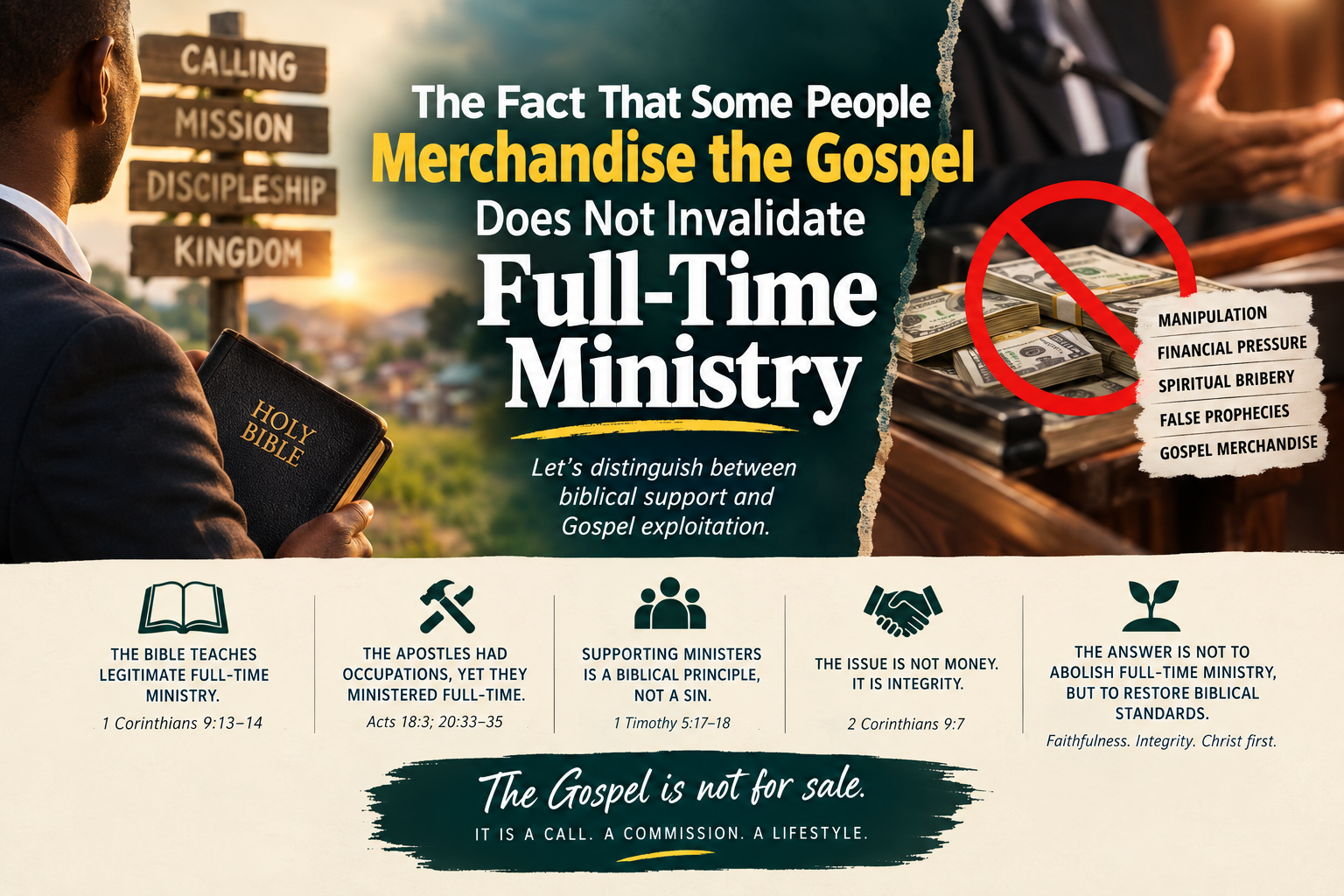
THE FACT THAT SOME PEOPLE MERCHANDISE THE GOSPEL DOES NOT INVALIDATE FULL-TIME MINISTRY.
Unfortunately, because some people have abused the ministry for financial gain, many have argued that there is nothing like full-time ministry and that every minister must have a secular job to prove that he is genuine.
I believe this conclusion is both unfair and unscriptural.
First, we must understand that nobody should merchandise the Gospel, manipulate people, manufacture financial pressure, or turn the pulpit into a marketplace and it is biblical to speak against this, clearly established in Scripture (2 Corinthians 2:17; 1 Peter 5:2).
However, we must not use the abuse of a biblical principle to invalidate the principle itself.
The Bible teaches that ministry is a divine calling and that the work of ministry can legitimately be someone’s full-time assignment.
In 1 Corinthians 9:13–14, the apostle Paul says:
“Do you not know that those men who are employed in the services of the temple get their food from the temple? And that those who tend the altar share with the altar [in the offerings brought]? [On the same principle] the Lord directed that those who publish the good news (the Gospel) should live (get their maintenance) by the Gospel.”
If you pay attention, you’d notice that Paul didn’t say that every minister must have a secular job, he acknowledged the Lord’s provision for those who devote themselves to preaching the Gospel.
In Galatians 6:6, the same Paul says:
“Let him who receives instruction in the Word [of God] share all good things with his teacher [contributing to his support].”
In 1 Timothy 5:17–18, Paul writes:
“Let the elders who perform the duties of their office well be considered doubly worthy of honor [and of adequate financial support], especially those who labor faithfully in preaching and teaching. For the Scripture says, You shall not muzzle an ox when it is treading out the grain, and again, The laborer is worthy of his hire.”
These are not endorsements of manipulation, but biblical grounds for supporting those who labour in spiritual service.
In fact, in 1 Corinthians 9:6, Paul specifically asked whether he and Barnabas alone were required to work for their own support.
Why would Paul defend the right of ministers to receive material support if his position was that every minister must earn a secular income?
Paul sometimes waived his right to financial support and he never taught that the right itself was illegitimate.
The early Church sharing things in common does not mean ministers were forbidden from receiving financial support.
Acts 2:44–45 and Acts 4:32–35 describe believers sharing their possessions to meet the needs among them. Acts 11:29–30 records believers sending relief to Christians in Judea.
The New Testament does not present one single financial arrangement as the compulsory model for every congregation, but it definitely doesn’t teach that ministers must never receive money from God’s people.
We must also remember that Jesus and His disciples received material support from people who ministered to them out of their resources (Luke 8:1–3). Our Lord Jesus was not ashamed to receive such support, and the writers of the Gospels didn’t condemn those who gave it.
The issue is not whether money changes hands, it is whether money is received and administered with biblical integrity.
Furthermore, having a secular job doesn’t automatically make a minister more spiritual, just as being in full-time ministry doesn’t automatically make another minister more genuine.
A person can have a secular job and still be greedy, manipulative, dishonest and covetous while another person devotes himself entirely to preaching, teaching, prayer, discipleship, evangelism and missions, receiving legitimate support from believers who willingly give, without exploiting anyone.
Let’s take for instance, the work of translating Scripture, training missionaries, planting Churches in rural communities, discipling new converts and reaching unreached people groups. Such kind of work often demands a person’s full attention, sometimes in places where there are few or no established Churches that are capable of providing financial support.
Do we expect such person to abandon the assignment simply because he cannot simultaneously maintain a secular job?
The Apostle Paul himself recognized different arrangements. Sometimes he worked with his hands; at other times, he received support from Churches, including the Philippians (Philippians 4:15–18).
The Biblical pattern allows both tentmaking ministry and ministry sustained by the voluntary support of believers.
It’s important that we distinguish between biblical financial support and the merchandising of the Gospel.
There is a difference between teaching believers that they have a responsibility to support genuine Kingdom work and manipulating them with threats, fabricated prophecies, transactional promises or financial intimidation.
There is a difference between receiving a freewill offering and selling spiritual access.
There is a difference between a Church supporting a minister who faithfully serves and a minister treating the congregation as a personal investment.
The Bible teaches in 2 Corinthians 9:7 teaches that giving should not be done grudgingly or under compulsion and also 1 Peter 5:2 warns spiritual leaders against serving for dishonest gain.
These warnings must be taken seriously. But they don’t in any way cancel the principle of 1 Corinthians 9:14.
Finally, the answer to the abuse of ministry is not to abolish full-time ministry but to restore biblical standards, financial accountability, contentment, integrity and the fear of God.
Let those who are called to work with their hands do so faithfully. Let those who are called to devote themselves fully to the ministry do so faithfully. Let Churches support genuine Gospel labourers without being manipulated, and let every minister remember that the ministry belongs to Christ, not him.
It is okay for us to condemn the merchandising of the Gospel but we should not also condemn the legitimate support of Gospel ministers.
We should challenge financial exploitation without making secular employment the universal test of ministerial authenticity.
A minister having a secular job doesn’t prove that he is genuine and a minister being in full-time ministry doesn’t prove that he is genuine either. The test is FAITHFULNESS to Christ, the TRUTH of the Gospel, the CHARACTER of the minister and the INTEGRITY with which the work is done.
Let’s correct what is wrong without discarding what is biblical.
Grace to you!