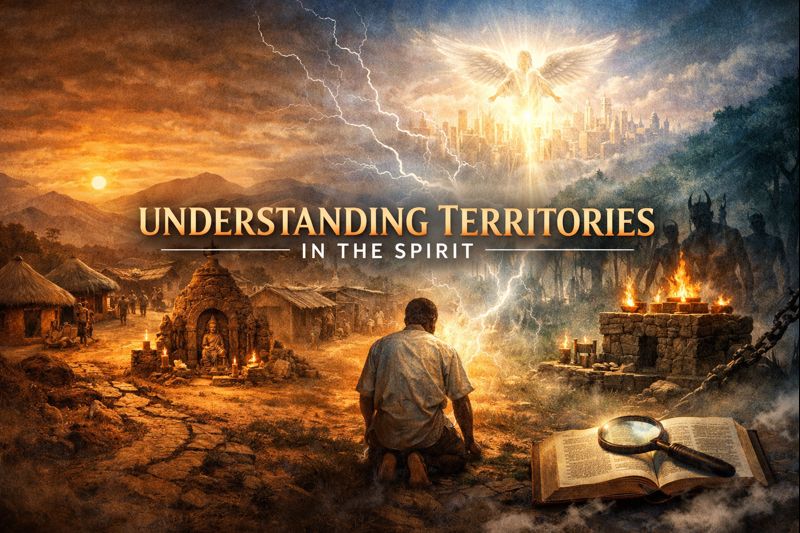
Obinna had learnt that when many people avoid the same land for different reasons, the land itself is usually telling a story no one was interested in listening to till the end, so he came at the end of the dry season, when dust clung to everything and patience wore thin. From the hill, he overlooked the village, and the village looked ordinary with mud houses being arranged without care, children chasing one another around the mud houses and the market square. While looking, nothing looked dangerous or out of place.
But Obinna had already trained his eyes to see what others don’t even perceive. He watched how conversations ended abruptly, how laughter faded quickly and noticed that every road leading out of the village was well-trodden, while the roads leading in looked faintly marched. He stayed when others passed through. Obinna noticed patterns others that were ignored.
Every harvest season ended in quarrels that spoilt farm harvests. Promising young people left and never returned. Nightimes carried a strange heaviness, laughter thinned and arguments rose high.
The village was not cursed in the way people can see on the surface level but it was bound by something far more dangerous which was a silent agreement with limitation.
And Obinna had come, not by accident, but because some territories only change when someone finally notices.
Long before Obinna learnt to read roads and seasons, he had learnt to listen.
As a boy, he noticed things others dismissed. He noticed keenly how quarrels followed certain words, how peace lingered in some homes and fled from others without explanation. When elders spoke, he listened not only to what they said, but to what their spirits carried.
Territories are more than physical spaces but they are spiritual jurisdictions that are shaped by histories, covenants, beliefs, and unseen influences and lands, like people, respond to authority. “From one man He made every nation of men, that they should inhabit the whole earth; and He determined the times set for them and the exact places where they should live” (Acts 17:26).
While God establishes territories, human response can alter their spiritual climate. Obedience invites alignment while rebellion corrodes atmosphere. When men walk faithfully, creation responds with cooperation but when they rebel, the land bears the weight (Leviticus 26:3–4). But again, “The land is defiled… therefore the land vomits out its inhabitants” (Leviticus 18:25).
The Bible reveals that words, actions, and beliefs can become legal frameworks over land and whatever is permitted repeatedly becomes established spiritually.
Territories do not shift overnight, they are shaped over time, by tolerated altars, unchallenged lies, and by agreements made in ignorance. And once a spiritual jurisdiction forms, it begins to instruct everyone born within it, setting invisible limits. Scripture calls this “the way of the land” (2 Kings 17:26) and this particular village had learned its own lessons well.
Hope was permitted, but only briefly.
Progress was attempted, but never sustained.
Departure was celebrated, but return was discouraged.
Like Obinna, disciples must learn to read environments spiritually, recognizing patterns, discerning atmospheres, and understanding what has been permitted to operate. Without discernment, believers would only respond to symptoms instead of causes and such will become like the simple who believes every word (Proverbs 14:15). When causes are ignored, cycles will always be repeated; when roots are untouched, fruit will always return.
God does not send disciples blindly because He expects understanding to precede action. Jesus Himself modeled this order. Before confronting spirits, He perceived them (Mark 1:23–25), before addressing cities, He discerned their condition (Matthew 11:20–24) and even in spiritual warfare, the Bible insists on clarity: “So likewise you, unless you utter by the tongue words easy to understand, how will it be known what is spoken?” (1 Corinthians 14:9).
Discernment is not optional but foundational when it comes to territories. Daniel understood by the books before he prayed (Daniel 9:2–3). The sons of Issachar were distinguished not by zeal alone, but because they “had understanding of the times, to know what Israel ought to do” (1 Chronicles 12:32).
Authority is consistently entrusted to those who understand.
Spiritual authority without spiritual intelligence leads to noise without victory. The sons of Sceva attempted confrontation without discernment and they were overpowered (Acts 19:13–16) but Paul reasoned, observed, and discerned the spiritual climate of Ephesus before challenging its strongholds (Acts 19:8–10, 23–26).
Seeing precedes speaking. Knowing precedes commanding and heaven only releases authority to those who move in alignment, not just assumption.
A disciple who reads environments spiritually does not panic at resistance. He recognizes permissions, does not rebuke everything but simply addresses what has been allowed. And when he speaks, he speaks accurately because “the weapons of our warfare are not carnal, but mighty in God for pulling down strongholds” (2 Corinthians 10:4), and strongholds must first be identified before they can be pulled down.
Spiritual intelligence is therefore not an academic pursuit but a requirement for stewardship. Wisdom guards authority. Discernment preserves effectiveness.
In the Kingdom, power does not begin with shouting, it begins with seeing.
Related Scriptures: Deuteronomy 11:24, Acts 17:26, Proverbs 24:3–4, Hosea 4:6, Luke 12:56
Confession: I receive spiritual understanding concerning the territories God has assigned to me. I discern patterns, atmospheres, and influences by the Spirit of God. I do not react in ignorance; I respond in wisdom. My eyes are open, and my spirit is alert, in Jesus’ name.
Weekly Bible Reading: Genesis 5