“How long wilt thou refuse to humble thyself before me? let my people go, that they may serve me.” Exodus 10:3
James Johnson’s parents were carried into slavery during the wars that tore through Yorubaland in the early 19th century which were the same wars that produced Samuel Ajayi Crowther’s story.
A British anti-slavery patrol freed them before the ship carrying them ever crossed the Atlantic, and they settled in Sierra Leone, where James was born in 1836, free from birth in a way his parents never had been. He trained at the same institution that had shaped Crowther, Fourah Bay College, and was ordained into the Church Missionary Society in 1866.
From the very beginning of his ministry, Johnson refused to accept that Christianity in Africa needed to look, sound, or be governed like Christianity in England. He baptized children with Yoruba names when other missionaries insisted on English ones. He argued openly, even inside CMS meetings and in print, that the Gospel belonged to every culture in its own form, that Christianity was never meant to be an European export requiring African people to become culturally British in order to be considered properly saved.
This did not make him popular with the mission establishment, but making him, in his own generation, the loudest Nigerian voice insisting that African Churches should be led, funded, and shaped by Africans themselves.
Then came 1890 which was the same year, the same crisis, like we had with Crowther, when the CMS moved to strip Bishop Crowther of authority over the Niger Mission, humiliating him in his own presence, Johnson did not stay quiet, writing to his fellow believers in unmistakable language, calling what had been done to Crowther a disgrace that had provoked righteous anger across the entire native Christian community, then warning that patience with this treatment had limits.
In 1899, the CMS finally offered Johnson a path to a full bishopric, but it came with a condition that he could personally raise ten thousand pounds (£10,000) towards the bishopric. Johnson threw himself into the task with everything he had, and by the time he reached the Gold Coast on his way home from England, he had already raised six thousand pounds, most of which was gathered largely through his own reputation and relationships. When he arrived back in Lagos, the mission authorities quietly blocked him from raising the rest, and made arrangements that left him with no post, no residence, and no clear role as the assistant bishop they had already partially consecrated him to be.
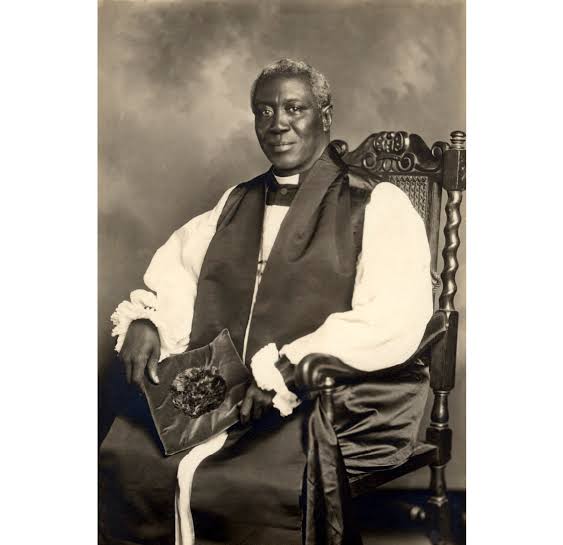
In 1900, he was formally made Assistant Bishop of the Niger Delta which was a real position, doing real work for nearly two more decades but the full bishopric he had raised sixty percent of the funding for himself never came. In the year 1893, two younger men who had not campaigned for African self-governance the way Johnson had were elevated to bishop status instead, in the very role he refused in protest because it would have placed him under permanent European oversight which he considered unjust.
He kept serving anyway, built up the Niger Delta Pastorate for the rest of his life, defended orthodox Anglican structure even while independent African Churches split away around him, sat on Nigeria’s Legislative Council as a voice for African interests, and became so trusted by ordinary Lagosians that when he died in May 1917, three thousand people attended his funeral service at St. Paul’s, Breadfruit, with a second memorial that was held entirely in Yoruba the following Sunday, because English could not hold everything the people needed to say about him.
He was called Holy Johnson in his own lifetime, not as flattery, but because everyone who knew him agreed there was no gap between what he preached and how he lived. He never got the title the mission had strung in front of him for over a decade. He got something the title could never have given him instead — a funeral that filled a cathedral with people who considered him, in every way that mattered, already exactly what he had never been officially allowed to become.
Johnson raised six thousand pounds of his own promised bishopric and watched the goalpost move anyway. He kept serving with full excellence in a title beneath the one he had already earned, for the rest of his life, without bitterness poisoning his ministry.
It is now unfortunate that it is in the same Nigeria that we have built a Nigerian Christianity where many quit the moment recognition is delayed, where a denied promotion or an overlooked title becomes an excuse to stop giving fully. Johnson gave three thousand mourners a reason to fill a cathedral for a man who technically never got the position he had earned.
Ask Yourself: are you serving for the title, or could you serve exactly this faithfully even if the recognition never comes at all?