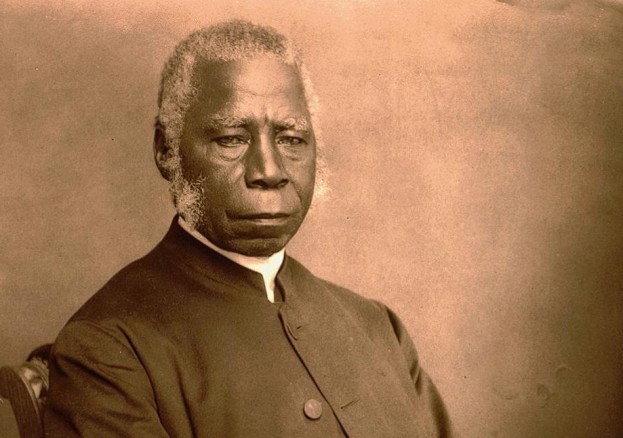
Samuel Ajayi Crowther | Osogun, Sierra Leone, the Niger | 1809–1891
“I have FOUGHT A GOOD FIGHT, I have FINISHED MY COURSE, I have KEPT THE FAITH.” 2 Timothy 4:7
He was around twelve years old when the raiders came for his village, Osogun, during the Yoruba wars. He was sold, chained, and put on a Portuguese slave ship bound for the Americas. A British naval patrol intercepted that ship on 7th April, 1822, and the boy they freed was resettled in Sierra Leone with a new name and a new life he had not asked for.
He became Samuel Ajayi Crowther, and what he built out of that stolen childhood was staggering.
He was educated at the mission schools in Freetown, ordained the first African priest in the Church Missionary Society in 1843, and produced the first Yoruba grammar the same year. He returned to the land he had been dragged out of, not as a stranger, but as a translator giving his own people Scripture in their own tongue.
In 1846, alongside Henry Townsend, he opened the CMS mission in Abeokuta, yes the same one we mentioned yesterday. He pushed further, up the Niger itself, building a mission that was staffed entirely by Africans, proving that:
Africans could lead African missions, ordain African clergy, and disciple African converts without a European standing over every decision.
In 1864, the Church of England made him a bishop. The first African bishop the Anglican Church had ever consecrated and that was something – for a boy who had, at a tender age, been chained on a slave ship now wearing the robes of a man trusted with the souls of a whole continent.
Then, slowly, the ground began to shift under him, not because his work failed, but because the people who had once celebrated him started deciding that an African was not, after all, fit to hold what he had built.
Reports began circulating in the 1880s accusing some of his African clergy of misconduct. Crowther, by then an old man, was blamed for their failures, though he had said for years that he had no funding to properly train or supervise them, a problem the mission never fixed. European overseers were sent to take control of the Niger Mission’s finances. His own missionary ship, the vessel that allowed him reach his scattered stations, was taken from him and turned into a trading boat, leaving him dependent on the goodwill of traders just to move along the river he had spent his life serving.
Then came the final humiliation.
In 1890, two junior European clergymen convened a finance committee and, in Crowther’s presence, the man who had ordained them, the bishop who had appointed them, went on to suspend three of his African pastors. He was not permitted to see the charges against his own clergy and not given a real chance to answer. He simply had to sit and watch it happen.
Crowther was over eighty years old. He resigned in protest that same year. He died the following December. The Church replaced him with a European bishop. What he had spent a lifetime proving, that Africans could lead the African Church, was quietly reversed by the very organization he had given his life to serve, in the space of a few short years.
Ask yourself:
What does it cost to build something faithfully, only to have it taken from your hands by the very people who decided you were never really the one meant to keep it?
Crowther’s story is not really about persecution from outside. Ibadan and Abeokuta already showed you that kind of cost. This is a harder wound because it shows the cost of being discarded from the inside, by your own household of faith, after you had already given everything.
There is a warning here for us as believers, and there is also a comfort.
THE WARNING:
We must be careful how quickly we imitate the very structures that once diminished us, how easily a Nigerian ministry can start treating its own most faithful workers the way Crowther was treated, the moment they become inconvenient.
THE COMFORT:
Crowther did not need the Church’s title to have already done what mattered. Every Yoruba believer who has ever read Scripture in their own language owes something to a man they will mostly never think to thank.
Are you building something you’re willing to lose the credit for, the way Crowther, in the end, lost his own bishopric but never lost what he had already given?