“A prophet is not without honour, save in his own country, and in his own house.” Matthew 13:57
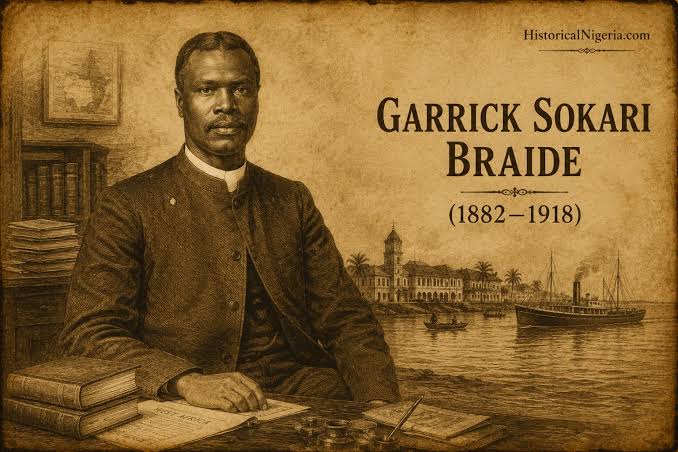
He was born around 1882 in Obonoma, in the heart of the Niger Delta, and grew up in Bakana, inside the very Niger Delta Pastorate that Bishop Samuel Ajayi Crowther had built decades earlier, which we already wrote about, was fractured by men who never fully trusted African leadership with African souls.
Braide was not baptized until 1910, at twenty-eight years old, and confirmed two years after that. Nothing in his early record marked him as anything other than an ordinary member of an ordinary Anglican congregation on the waters of Niger Delta.
Then something broke open in him that the mission structure had no structure, plan and patience for. Braide did not simply attend Church, he began to preach against the idols and traditional shrines that still stood in Delta communities, urging people to destroy them outrightly, preached hard against alcohol, which was a direct hit on trade gin, one of the most profitable imports the colonial economy depended on, prayed for the sick and watched them recover, and the people around him began calling him a prophet, whether the mission gave him that title or not.
By 1915, mass baptisms were happening under his ‘ministry’ on a scale the Niger Delta Pastorate itself had never managed to produce through ordinary means and in a matter of a few short years, his movement is estimated to have reached over a million people in a region where the Gospel had spread slowly for the better part of a century.
It was obvious that he never wanted to leave the Anglican Church because his own desire was to remain inside the structure, revive it from within, and not found something separate from it. But a movement that size, led by a man the mission hierarchy had not trained, ordained, or authorized, was more than the Niger Delta Pastorate Board could tolerate. They moved against him, and here is the detail that should stop everyone reading cold: the very structure Crowther and Johnson spent their lives trying to build into something Africans could fully lead turned around, within a generation, to shut out one of the most effective African evangelists it had ever produced.
The colonial government moved against him too, and for a much more obvious reason, his preaching against alcohol was hitting tax revenue where it hurt. He was imprisoned in 1915 on charges tied to fears of unrest, arrested again in 1916, this time on a formal charge of sedition, and held for roughly two years. He was finally released in 1918, before which his health already broke by the imprisonment and he finally died within days of walking free, on November 15th, 1918, under circumstances his own followers considered suspicious enough that they never fully accepted his death as simply natural.
THE MOVEMENT DID NOT DIE WITH HIM!
Followers who felt abandoned by both the colonial government and the Church that had once welcomed Braide’s revival went on to found the Christ Army Church, which was one of the earliest African independent churches in Nigerian history. The Anglican mission itself, watching members leave for Braide’s movement in large numbers, was eventually forced into genuine indigenizing reforms it had resisted for decades.
Historians now count Braide among the earliest roots of Nigerian Pentecostalism itself, a lineage running from a fisherman-turned-prophet in the Niger Delta, imprisoned twice and dead at thirty-six, straight into the Pentecostal fire that would eventually sweep across all of Nigeria.
Braide never asked to leave the Church, it was the Church that could not hold what God was doing through him, and the colonial government could not afford to let it continue, so between the two of them, they locked him away until his body gave out. He died having been imprisoned by both the empire and the institution that should have celebrated him.
You see how history has always shown the extent of corruption that has eaten deep into the Church.
We have built a Nigerian Christianity that still, generation after generation, struggles to make room for genuine revival when it does not arrive through the expected channel, wearing the expected credentials. Braide’s whole story is a warning against mistaking institutional control for spiritual authority.
If God moved through someone in your own circle in a way that did not fit the structure, would you recognize the fire, or would you be the one reaching for the lock?